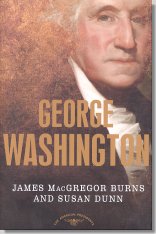
Wealthy Virginia planter, revolutionary general, and founding president,
George Washington was the most illustrious public man of his time, a man whose
image today still reflects his own careful shaping of his persona.
As president, Washington built almost unimpeded power into the executive
branch, not only occupying the office but virtually conquering it. And yet his
was by no means a one-man presidency. James MacGregor Burns and Susan Dunn
demonstrate that Washington built a collective leadership never to be surpassed
in American history. He succeeded brilliantly in creating a strong sense of
national unity while failing markedly in trying to foster political unity,
believing that it was possible to dissolve political differences and banish
opposition. His moral legacy would also be mixed, for he feared that discussions
of slavery would threaten the survival of the young republic. But in the end the
presidency itself would be his ultimate achievement; it would undergird every
future president who would seek to offer strong and determined leadership.
As a public figure Washington could be difficult to decipher. At key moments
in his life he seemed to want to shun the spotlight, disquieted by the
responsibilities of power. He dreaded his inauguration, announcing that he felt
like "a culprit going to the place of his execution." And yet he always happened
to be in the right place at the right time. Burns and Dunn probe behind his
virtuoso performance of self-effacement and discover a supremely ambitious man
determined to be at the center of events.
In this thoughtful and incisive biography, Burns and Dunn dissect the
strengths and weaknesses of Washington's presidential leadership, from his
lasting foreign and economic policies to his polarizing denunciation of
political parties and his public silence about slavery. The result is a
surprising portrait of the multidimensional man behind the myth he so
assiduously crafted.